Here in northern Israel, the rockets have stopped falling for the time being. Hezbollah agreed to a ceasefire with Israel in November. Now we’re all praying that the ceasefire will extend to Gaza and that our hostages will finally be released.
Of course, the situation is far from perfect. Ceasefire is certainly not the same as peace. Both Hamas and Hezbollah are re-arming and strategizing future attacks on Israel even as they negotiate peace. The Houthis in Yemen continue launching missiles at Tel Aviv and Jerusalem. The situation in Syria is volatile and potentially dangerous. And none of us know the horrors that our hostages will tell once they finally return from Gaza.
But despite everything that is so wrong, this lull in rocket fire from Lebanon gives those of us living in the north a moment to breathe. We’re getting a break from booms and sirens and the mad rush to get to a bomb shelter when the alarm sounds.
Along with this sense of relative calm comes a little time and space to begin processing everything that has happened since October 7th 2023.
When I speak to Israeli people, many are having the same sort of experiences at the moment. Many of us feel tired and heavy. We have headaches and other illnesses that just seem to drag on and not get better. Many lack energy and motivation. It feels like there’s a heavy cloud hanging over us that we can’t quite put into words.
For my own part, I know that the way I’m feeling now is one of the after-effects of living off adrenaline for so long while the rockets were falling.
During that time, I felt like superwoman. Courageously and defiantly refusing to give in to fear. Drawing upon endless reserves of energy and resilience. Imparting strength to my whole family.
But I probably always knew that somewhere down the line there would be a crash. That I would have to work through the fear, grief and confusion that I couldn’t allow myself to feel while the drones and rockets were coming.
This is the space I’ve been in for the past month. Processing. A dull ache above my eyes seems to be my body’s way of telling me that I have tension trapped inside that needs to be released.
*
A couple of weeks ago, Colin, myself and the children went away on our first holiday within the land since the war began. We stayed in the Galilee and made some trips up into the Golan.
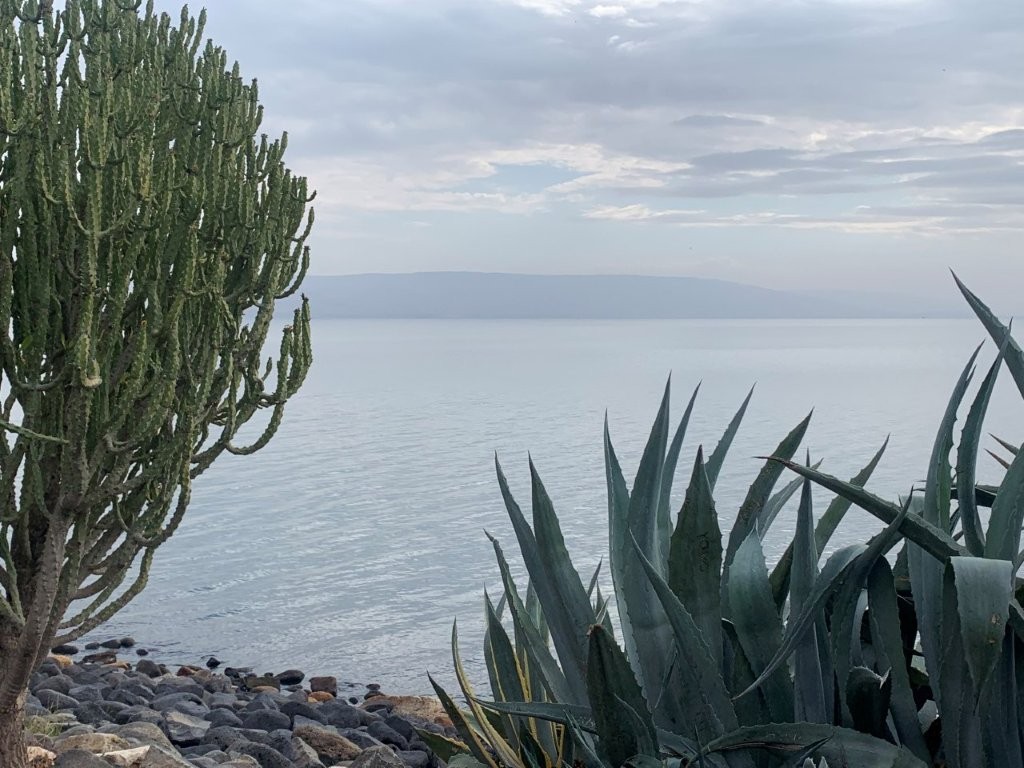
As I looked out over the shimmering waters of the Galilee from our holiday cabin, the words of Isaiah 9:1-2 became real for me in a whole new way:
“Nevertheless the gloom will not be upon her who is distressed, As when at first He lightly esteemed
The land of Zebulun and the land of Naphtali,
And afterward more heavily oppressed her,
By the way of the sea, beyond the Jordan,
In Galilee of the Gentiles.
The people who walked in darkness
Have seen a great light;
Those who dwelt in the land of the shadow of death,
Upon them a light has shined.”
I imagined the fisherman in the days of Yeshua – poor, tired, burdened, probably quite afraid, paying heavy taxes to an oppressive Roman government that cared nothing for ordinary Jewish people like them. The Jews of the Galilee were also looked down upon by their Judean brethren living in Jerusalem, who may have imagined that their proximity to the temple gave them special favour in the eyes of God.
Surely the Son of God and Saviour of the world would have chosen to live and minister in the great city of Jerusalem.
But no. Yeshua chose to be born to a young girl with no fame or fortune in a cold and dark animal shed. And he chose to base his ministry in the obscure backwaters of the Galilee.
“God has chosen the foolish things of the world to put to shame the wise, and God has chosen the weak things of the world to put to shame the things which are mighty.” – 1 Corinthians 1:27
As I reflected on these first century Galilean fishermen, I felt a certain affinity with them. I began to understand a little more about the “great light” that drew them like a magnet.
Living through this war has given me a deeper understanding of fear. In the movies, fear is presented as a simple and straightforward emotion. The characters experience an intense adrenaline rush as disaster strikes – be it an earthqauke, flood, fire, volcano, armed robber or evil terrorist. As the adrenaline kicks in, the protaganist in the story performs great acts of heroism that save the day. There’s normally also a coward in the movie who serves as a contrast to the hero. The coward seeks to save himself when the danger comes and throws everyone else either literally or metaphorically under the bus. After the threat has passed, the hero walks away with his head held high (and normally a beautiful woman in tow), while the coward is either dead or, worse, condemned to a life of guilt and shame.
The truth is that fear is much more complex than this. Especially the type of fear that goes on for a prolonged period of time.
Since moving to Israel with Colin nearly sixteen years ago, I have experienced many different types of fear. Fear of not have enough money. Fear because I felt all alone in a new country where I didn’t understand the people or the language. Fear because I didn’t know who I was anymore in this strange land and felt like I was drowning. Fear of never having children. Then fear of losing the children I had grown to love as the adoption process dragged on. When the adoption was complete, there were different fears. Fears of not being able to manage the children’s needs. Fears of failing them. Fears as I stood up and advocated for them within health and education systems that were often far from supportive.
When Hamas crossed over the Gaza border on 7th October 2023, it wasn’t my first run-in with fear. But it was certainly a different sort of fear than the ones that I had experienced up until then. A real, concrete fear for my life. And even worse than that, a fear that I would not be able to keep my own children safe – physically or emotionally – in the face of the dangers that lay ahead. As the months wore on, another fear crept in – fear because I felt alone and rejected by the rest of the world as anti-Israel and anti-Jewish ideologies swept across the globe. I began to experience the fear and bewilderment of Jewish people through the ages… “Why us? Why me?”
Of course I can’t put myself exactly in the shoes of those Jewish fishermen two thousand years ago, but as I looked out over the Sea of Galilee on the first evening of Hanukkah – which also happened to be Christmas day – I felt like I understood just a little bit of what it must have felt like to “dwell in the land of the shadow of death.”
The type of fear experienced by heroes in the movies is a world away from the dull, unrelenting, aching fear that Jews living under Roman occupation would have felt every day. Their fear would have skulked in the background of their day-to-day lives as they worked, ate, slept, married and raised their children, casting an ominous shadow over every aspect of life and never quite going away.
The hero in the movies has the power to do something about his fear. And that sense of power makes all the difference in the world. He has the strength, the energy, the skills, the knowledge to defeat the enemy. Even though the battle may be fierce, we all know – and so does he – that in the end, he will save the day.
As much as the Galilean fishermen in the days of Yeshua may have longed to rise up and overthrow the Romans, the truth is that they didn’t have the power. On the rare occasions that Jews stood up against Roman rule during that period of history, the story always ended either with a brutal massacre or a desperate act of mass suicide. Like the community of Jews who died by their own swords at Masada in AD 73, moments before the Romans breached their defences. The mountains around the Galilee can also tell stories of mass Jewish suicides carried out as tragic acts of resistance against powerful Roman garrisons.
In my own experience, the hardest type of fear to cope with is fear that is accompanied by powerlessness. The sort of fear that comes when we are faced with terrifying realities that we have no power to either change or escape from. This sort of fear makes us feel weak. It strips away our self-confidence. It presents us with a choice that feels impossible. Do we keep on fighting a battle that we are unlikely to win and that will probably end up hurting us, or do we stop resisting and try to live the best we can within a reality that feels oppressive and frightening?
During this war, I have learnt that the Bible has a lot to say about how to live in the presence of evil. Psalm 23 has become a lifeline for me:
“The Lord is my shepherd;
I shall not want.
He makes me to lie down in green pastures;
He leads me beside the still waters.
He restores my soul;
He leads me in the paths of righteousness
For His name’s sake.Yea, though I walk through the valley of the shadow of death,
I will fear no evil;
For You are with me;
Your rod and Your staff, they comfort me.You prepare a table before me in the presence of my enemies;
You anoint my head with oil;
My cup runs over.
Surely goodness and mercy shall follow me
All the days of my life;
And I will dwell in the house of the Lord
Forever.”
Though we may find ourselves in the valley of the shadow of death, we need fear no evil because our Father God prepares a banquet for us even as our enemies camp out all around.
I can testify from personal experience that there really is a God-given, supernatural grace to live in the presence of evil. A banqueting table that exists in spiritual realms though the physical realities around us may be bleak.
During the most intense period of the war, as missiles were coming at us from Lebanon, Iraq, Iran and Yemen, I experienced this safe place of supernatural peace under the shadow of the Almighty.
I believe that this was the place that Yeshua called his disciples into.
“Follow me, and I will make you fishers of men,” he said (Matthew 4:19). At once, they left their nets, their security, their livelihood, and everything they had ever known and walked into the light.
*
I believe that God wants to shine his light once more upon the land of Israel. The darkness that we are living in today is very deep, but I believe that the hope and revelation that God wants to pour out upon us is deeper still.
The prophet Isaiah spoke of a future time when righteousness and salvation would shine out of Israel, bringing light to the rest of the world.
“For Zion’s sake I will not hold My peace,
And for Jerusalem’s sake I will not rest,
Until her righteousness goes forth as brightness,
And her salvation as a lamp that burns.
The Gentiles shall see your righteousness,
And all kings your glory.” – Isaiah 62:1-2
I personally believe that Yeshua’s words to those weary and burdened first-century fishermen on the shores of the Galilee hold the key to the coming revival.
“Follow me, and I will make you fishers of men.”
Yeshua didn’t just stand on the shores of the Galilee and preach a sermon to the fisherman as they prepared their nets. He didn’t just throw them a few pearls of wisdom or give them a book as he passed by. Instead, he invited them to follow him, to accompany him on the journey, to walk with him, to eat with him, to rest with him, to heal the blind and lame alongside him. He invited them to be his closest friends.
Yeshua told his disciples that their lives had meaning and purpose. “I will make you fishers of men,” he said. There was an important work for them to do. This work perfectly matched their natural aptitudes and giftings. They already knew how to fish. But Yeshua wanted to train them to take this skill to a whole new level.
By telling these poor and heavy-laden fishermen that he had an important assignment for them to do, Yeshua was also communicating to them that they were not powerless. They may not be able to overthrow Rome, but their lives still had great value and there were things they could do that would have eternal significance.
How many of us today, if we’re honest, feel lonely and insignificant – sometimes even within thriving faith communities where we are fully plugged in and actively serving? I believe that the deepest cry of the human heart is for authentic relationships and a sense of purpose. Yeshua called out to these God-given yearnings when he invited his disciples to follow him.
I believe that the day is coming when multitudes of people in Israel and all over the world will once again be drawn to the light, just like the crowds were that flocked to Yeshua in the Galilee two thousand years ago. And I believe that this revival will be marked by close and authentic relationships, and by people discovering and stepping into their individual and God-given giftings.
Our world today is full of people who are lost, lonely, hurting and afraid. Many of us are crying silent tears, battling a sense of oppression that feels too dark and too heavy to even put into words. The world feels dangerous and confusing, but we don’t know how to put it right.
Two thousand years ago, the people walking in darkness saw a great light. Come, Lord, and shine your light upon us once again.
 Higher Than Me