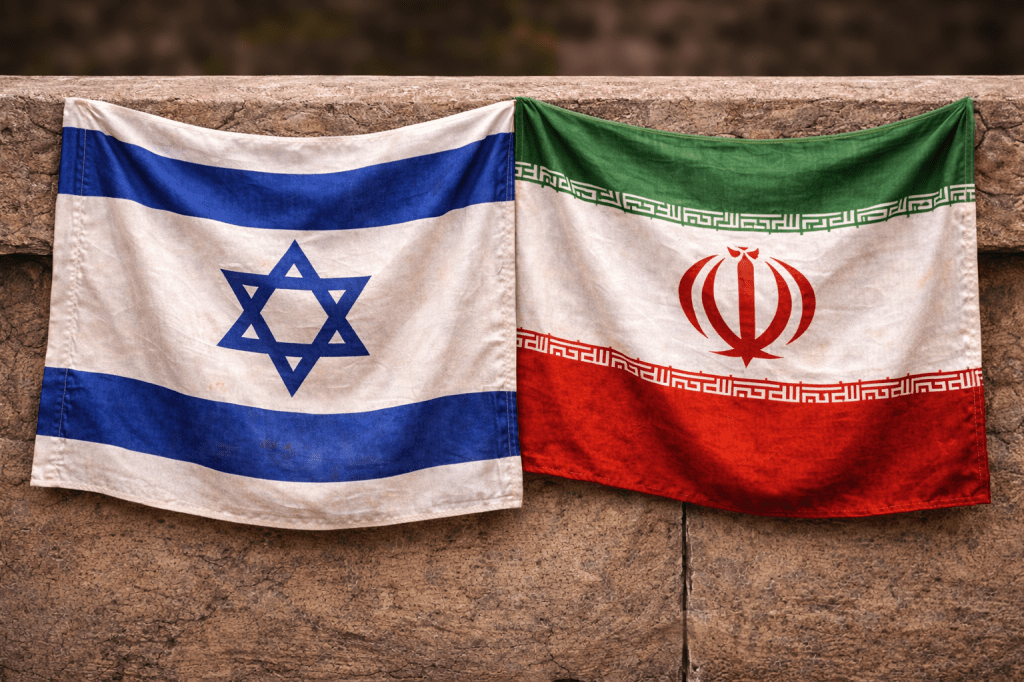
At 8.30am on Saturday morning, as sirens wailed out across Israel, letting us know that the country had entered a state of national emergency after the US-Israeli strikes on Iran, everyone in our family knew instinctively what to do.
Within a split second, the children stopped what they were doing (planning the Purim costumes they were going to wear to our Shabbat celebrations), grabbed their water bottles from the fridge, and moved into Hannah’s bedroom — our bomb shelter.
Up until that moment, the children had known nothing about the stalling negotiations and build-up of war rhetoric leading up to the strikes. Even though Colin and I knew the conflict was coming, we chose not to tell the children. It wouldn’t have benefited them to know and would have caused unnecessary anxiety.
But when the sirens sounded on Saturday morning, we all knew exactly what to do. We’ve been here before.
I wish we didn’t have to go through this again. I hate the war routine. The sirens and booms. Staying close to a protected space and carefully weighing up any excursion outside the home. Trying to keep routines as normal as possible for ourselves and the children, while knowing that any activity could be interrupted with a minute’s notice to get into a safe room. Living with a sense of danger in the air. Hearing sirens even when there aren’t any. Scrolling through the news when we hear explosions and reading about the missiles that didn’t get intercepted, or the falling pieces of shrapnel that damaged homes or took lives.
There is nothing glorious or romantic about war.
But sometimes it is necessary.
Much of the world is looking on in horror at the scenes unfolding in Israel, Iran, the Gulf and now also Lebanon and Cyprus. Many are asking why. What reason did Israel and the US have for striking Iran? Was it really worth the cost — the global fallout, the devastation, the loss of life, the escalation that could lead to who knows where?
I understand these questions. My own family is in the firing line. It’s impossible to predict how this will unfold or how messy it may become. I also have reservations about the two men currently heading up this campaign — Donald Trump and Benjamin Netanyahu. I often disagree with their political positions.
But one thing I have learned living in this region is that non-action in the face of threat is rarely the safe or responsible choice. Sometimes action — with all its risk and uncertainty — is less dangerous than doing nothing.
The Iranian regime poses a threat not only to Israel, but to the whole world. For decades, it has acted as a sponsor of terror across the Middle East and beyond.
Last June’s war set Iran back militarily, but the evidence suggests that it quickly resumed enriching uranium and rebuilding its weapons capability. Processes like this do not happen without an end goal.
At the same time, the regime has continued to brutally suppress its own people. In recent months many thousands of Iranians have risked their lives to protest against the government, only to face violent repression. Around the world, the Iranian diaspora is crying out for their country to be set free from the dictatorship that currently rules it with ruthless control.
When news of the death of Ayatollah Ali Khamenei broke, Iranians living in the UK, the United States, Canada and elsewhere took to the streets to celebrate. For many, it felt like a moment they had waited decades to see — the possibility that the tyrannical regime holding their people hostage might finally be coming to an end.
At many of these gatherings, Jews and Israelis stood side by side with their Iranian brothers and sisters. They remembered the Iranians who had stood with them after the horrors of October 7th, and once again these two peoples found themselves standing together — united by a shared understanding of the evil of terror and a hope for freedom.
Many people don’t realise the long history that Jews and Iranians share — two ancient peoples whose stories have crossed paths many times, long before the current regime came to power.
For both peoples, the timing has not gone unnoticed that these latest military strikes are happening during the Jewish holiday of Purim.
Purim remembers the story told in the biblical Book of Esther, set in the Persian Empire more than two thousand years ago. In this story, the Jewish people faced a plot to destroy them, planned within the court of a powerful ruler. Through courage, unlikely alliances and a remarkable turn of events, the plan was exposed and the Jewish people survived.
The Persian Empire in which the story of Esther unfolded included the land that is modern-day Iran.
Of course, today’s realities are far more complex than the events told in the Book of Esther, and we should not try to draw neat parallels. Nor is there any place to romanticise what is happening now or to respond with triumph. The human cost of war is all too real. But neither should we give in to cynicism. History does contain stories of courage and freedom, of oppressive rulers falling and new possibilities emerging. Conflicts do not always lead to endless chaos and bloodshed, as many fear. Sometimes new futures do take shape. Sometimes peace does come on the other side of war.
Here in Israel, many of us are hoping and praying, standing in spirit alongside the strong and courageous people of Iran — the protestors who have risked their lives to challenge the regime, and the Christians who have endured decades of persecution. Without being naïve about the dangers of this moment, we believe that out of the ashes a new day may yet arise.
 Higher Than Me
Hello from England, thank you for your update and I pray the Lord will keep you all safe. I get regular updates from “Behold Israel” but you are living through the war and feeling it. Stand firm in the Lord and I pray the war will end as quckly as it begun. God bless.
LikeLiked by 1 person
I agree Helen. It was horrible waiting to see if the Iranian people’s faith that aid would come was well placed or not. US and Israel are doing the work for the rest of us, only sorry that our UK dithering is endangering lives.
We do pray there may be some upsides for the children, who are so blessed to have your care for their safety and growth. They look great! Two beauties.
LikeLiked by 1 person
Thank you for your update on your family Helen! I/we pray from Austria for you and your safety. May His peace that surpasses all understanding fill your hearts and minds!
LikeLiked by 1 person
Dear Helen it’s so good to hear from you in the midst of such difficult times. I’ve heard from others that you have been getting multiple alerts every night – the sleep deprivation must be such a stretch on top of all the layers of difficulty you describe. I marvel at the resilience I hear in your words, the clear eyed realism, the many troubling concerns, and the hope that something good may emerge from the ashes of this war. I pray with and for you, your family, and the people of Israel and Iran, and I hold that hope with you. God bless you! May His steadfast love, continual protection, abiding presence, and abounding peace be your portion. 🙌🙏❤️
LikeLiked by 1 person