On 3rd February, twenty-five days before the outbreak of war with Iran, Yaakov planted a cherry tomato in a pot of soil at his weekly social group to celebrate Tu Bishvat.
Tu Bishvat, known in Israel as the “New Year for Trees,” is a holiday that celebrates trees, plants, and the renewal of the natural world. Although it is not a biblical festival, it has been an agricultural tradition since ancient times. In recent centuries, Tu Bishvat has become associated with planting trees and restoring the land of Israel.
The Tu Bishvat event at Yaakov’s social group on 3rd February was a challenge for him.
He has been in home education for the last two years following significant school trauma. Helping him rebuild his social confidence since then has been a slow process with many ups and downs.
This social group is a bit like Scouts. The children meet each week in a school building, with different age groups in different classes.
When Yaakov first joined the group in October, he could hardly even enter the classroom. He would sit at the back of the room holding on to me tightly and not looking at anyone else.
By February, he had relaxed enough to engage with some of the older teenage helpers. But the Tu Bishvat event was still a stretch.
All the groups were together in the school playground with stalls and different activities. There was noise and bustle and lots of children. Yaakov couldn’t bring himself to join in and preferred to sit quietly inside a classroom with one of the helpers.
At the very end of the event, one of the girls asked Yaakov if he wanted to plant a tomato to take home. After a lot of encouragement, he agreed to come outside. With his coat over his face so no one would see him, he took a pot of earth, dug a hole and buried the tomato.
For me, the potted tomato wasn’t the main thing. I was just proud of Yaakov for having the courage to join in.
I paid half-hearted attention over the next few weeks as he faithfully watered his little plant, and tiny green shoots began to appear. But when the first siren went off on 28th February, I was no longer thinking about tomatoes.
*
I haven’t written a post on this site for a couple of months because, quite honestly, I’ve been lost for words.
It’s impossible to organize this experience into sentences that make sense with tidy full stops at the end. It feels like we’ve moved beyond language.
We had six weeks of intense rocket fire from Iran and Hezbollah in Lebanon, followed by an ominous peace that could break apart at any moment. During this so-called ceasefire, military exchanges are continuing between Israel and Hezbollah in the north.
For six weeks, we stepped out of normal life and into a dream-like sequence of sirens, rockets, explosions and dashes to the bomb shelter. We saw and heard buildings being hit nearby. We read reports of people killed. One night, a rocket was intercepted directly over our apartment block, and I heard the shrapnel ricocheting off our garden fence.
The surprising thing is how little I felt during that period. It makes me think of a spinning top. If you put a brightly coloured spinning top on the floor and turn it fast enough, the individual colours blur together and the top appears grayish-white.
The same thing happens with our emotions under rocket fire. The fear, the dread, the horror, the anger and a hundred other feelings spin together and become a sort of nameless, numb veneer.
During the whole six weeks, I don’t remember feeling scared. I just continued to function. I cooked. I made the beds. I went to the shops. I taught the children. I even managed to engage in sensible conversations with family and friends outside the country. “We’re all ok here. Staying safe. The children are holding up.”
But underneath it all, the wheel was spinning at a dizzying speed and everything else seemed to merge and lose its edges.
*
I have always been interested in mental health, and in recent years I have found myself wondering more and more where the line falls between ordinary human distress and psychiatric illness.
Part of this has come out of my own journey, accompanying Yaakov through school trauma. I have seen how some of his behaviours may look unusual to other people – like covering his head with a coat when he enters a classroom full of children. But for me, knowing his history and life experiences, these behaviours make perfect sense.
For some time, I have wondered how many of the conditions that we label as mental illness are actually the mind and body doing what they can to make sense and survive in the face of events and circumstances that are themselves overwhelming or incomprehensible.
After living through weeks of direct rocket fire and then more weeks of uncertainty on an existential level, I can see how easily our very sense of reality can distort under significant stress. When the world outside stops behaving in normal ways, it feels like the ground itself is no longer solid. Minutes and hours sometimes seem to disappear from the day. Familiar facts vanish from our minds. We can set out on a journey and then forget where we’re going and end up somewhere else entirely, miles away.
On one occasion, in between sirens, I forgot how to tell the time. I had to google which was the long hand and which was the short one. During prolonged periods of stress, anyone can go mad. And people do. The rates of mental illness in Israel are rising sharply. As well as high levels of anxiety and depression, many children and adults are also experiencing bizarre symptoms and distorted perceptions of reality that they don’t understand.
It’s painful and frightening. But, given what we’re living through, it also makes sense.
*
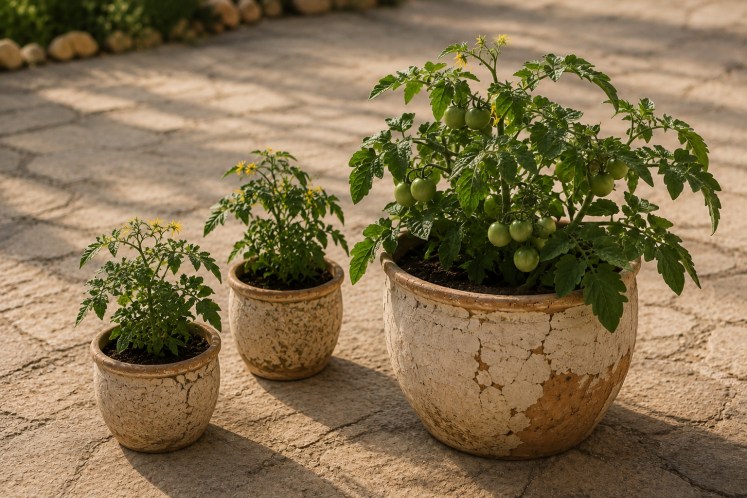
During those six weeks, in between rockets and sirens, Yaakov continued to water his tomato plant. It grew so much that we had to find a bigger pot. And then we needed even more pots for all the newly sprouted seedlings. We now have three flowering tomato vines and the fruit is beginning to grow. Yaakov is thrilled!
Somehow, despite all the stress and uncertainty of these recent months, Yaakov himself is thriving. When his social group resumed after the ceasefire, he was beyond excited to see everyone again. Rather than just sitting on the side, he wanted to take part in the group activities. Last Tuesday, for the first time ever, he was happy for me to leave the building and wait for him in the car outside.
It makes me wonder what other fruit might possibly grow in this present soil of grief and tears.
*
At this time of population-wide stress and trauma, I can picture a different way of responding to emotional distress, marked more by acceptance and compassion than by fear and labels.
The science for this new model of mental health already exists. Evidence shows that healthy, authentic relationships and a sense of social belonging can offset or reduce the severity of many mental illnesses.
Families and communities experiencing trauma, with all its strange and confusing symptoms, can reconnect with the ground beneath their feet by coming together, being real, cooking, eating, laughing, crying, moving together and engaging in normal rhythms of life.
Here in Israel, most of us are experiencing some form of stress, although it appears differently for different people. Maybe this is actually an opportunity in disguise. Maybe we can use this moment to come together in a more authentic way, with greater kindness and understanding. Maybe we can learn that we don’t need to be afraid of one other. That no one needs to be outside the circle. We have a God who leaves the ninety-nine to search out and bring home the one. Maybe we can take His hand and allow Him to lead us into this same depth of compassion.
*
As I look at the tomato vines sitting in their pots outside our patio window, I am reminded of the symbolism of Tu Bishvat.
In the early nineteen hundreds, before the creation of the modern state of Israel, Jewish schools and communities in the land would hold special ceremonies on this day. In a land damaged by centuries of deforestation, overgrazing, erosion, swamp conditions, and neglect, planting trees became a practical way of reclaiming and restoring the ground. On Tu Bishvat, children went out to plant saplings as part of a collective vision of renewal.
Maybe now is the time to plant again.
Our land is bruised by war and wet with tears. But there are seeds that grow best in broken ground. Not trees of pride or self-righteousness, but trees of humility, mercy and truth. Trees beneath whose branches wounded people can sit together in safety. Trees whose leaves might yet bring healing to the nations.
“Those who sow in tears
Shall reap in joy.
He who continually goes forth weeping,
Bearing seed for sowing,
Shall doubtless come again with rejoicing,
Bringing his sheaves with him.”
— Psalm 126:5–6
 Higher Than Me