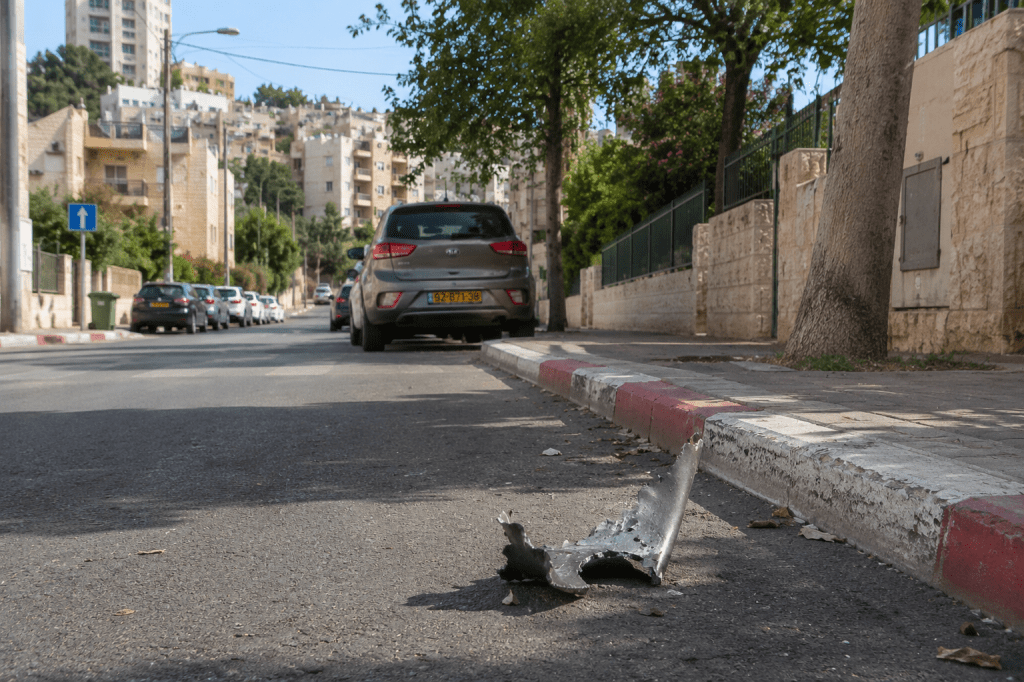
Here in Israel, when missiles enter our airspace, if they are heading for populated areas, they are normally shot down in the sky.
Of course, there are still some rockets that get through and make direct impact, but most of the time, missiles are intercepted overhead.
Because of the effectiveness of our air defense systems, the greatest danger for people in Israel is often not so much from the rockets themselves as from falling shrapnel. This is why we wait in our bomb shelters for ten minutes after a siren sounds.
Since the beginning of this brutal war, there have been many injuries and deaths, as well as damage to homes and infrastructure caused by falling fragments of rockets and interceptors.
But there’s something else I’ve also noticed. When I talk to friends here, and when I stand back and try to observe my own feelings and responses, I see that people too can break into fragments.
When you’re living in a war zone, you have to find ways of blocking out unbearable realities. It’s a matter of survival. There is only so much fear and horror that human beings can consciously hold.
After the events of October 7th, the internet was awash with gruesome images and video footage of the attacks that took place on that day. Many people in Israel who were not directly affected by the massacres experienced secondary trauma after seeing those films. I couldn’t look at them. To this day, I struggle to listen to survivor testimonies, even though I care deeply and believe that they need to be shared.
Exactly a week after October 7th, my family took a British government evacuation flight out of Israel. The children and I stayed in the UK for a month while Colin returned to the country.
During that month, I longed to be able to dissociate, even briefly. I felt a strong force pulling me inwards, wanting to take me into some space inside my head where I could zone out and shut off reality for a while.
But my circumstances meant that I couldn’t really give in to the pull.
I was responsible for two young, traumatized children who called me back into the moment whenever I tried to escape into my own thoughts. I had to be available for the constant stream of “mummy, mummy”s.
Neither child was happy to play quietly by themselves during that time. They were too anxious. They wanted my full, undivided attention.
This tension between being present and zoning out often plays out in our home when the siren sounds. During those moments, sitting together in our apartment’s bomb shelter – Hannah’s bedroom – my instinct is to be quiet, to allow my thoughts to take me wherever they want to go, to maybe say a silent prayer, or just to emotionally detach and scroll through my phone.
But during those times, more than ever, the children want me to be present. They compete for my attention. They want to tell me how they’re feeling, for me to listen to a song they’ve made up, or to play a game with them.
Sometimes I need to tell them that, although I know they’re feeling anxious, I just need a few moments alone in my head. But at the same time, I do understand their need for my attention.
I have come to believe that staying connected to each other emotionally is one of the most important things we can do during times of stress and trauma. And even though the children’s pull on my attention sometimes feels like a wrench, in many ways it has helped keep me stable over the last three years as the ground has shifted beneath my feet. Without the children, I may have fallen into a hole of my own thoughts.
The children have often brought laughter and playfulness into stressful situations. Even the chaos and conflicts that break out between them and because of them somehow keep our feet on the ground. They help us all to stay human.
The children have also helped me to find language for things going on around us that sometimes seem inexplicable. Because of them, I have had to search inside myself for the words to explain war and missiles and hostages and terror. Otherwise, I expect these realities may have just remained in my soul as wordless fragments of horror.
I also thank the children for helping keep me in touch with my own emotions. As adults, our conversations often remain one step away from emotional reality. We can talk about policies and politicians that we disagree with. We can talk in general terms about trauma and mental health. But many of us would struggle to say something as simple and vulnerable as, “Right now, I feel scared.” Somehow it feels too exposing, too childish.
Sometimes I think that I have learnt more about communication from my autistic eleven-year-old son than I have from anyone else in my life. He says things as they are. He repeats over and over how scared he feels, or angry he is with the people who are sending the rockets. Don’t they know that they’re frightening us? Why do they hate us so much?
Sometimes it’s tempting to throw out some meaningless reassurance like, “Don’t be scared, it will all be ok.” And sometimes there really is a time to interrupt the fear narrative with words of hope and courage. But before Yaakov can internalise a message of resilience, he has to feel that his fears have been taken seriously. In order to hold his hand and lead him out of the shadows, I need to first enter into his emotional reality myself. “Of course you’re scared,” I say. “It’s normal. Sometimes I get scared too.”
Seeing Yaakov unashamed of his own feelings has given me the courage to own mine, too. And I have come to realise how much of a gift this really is.
Many people I talk to feel like there’s something wrong with them when they experience fear, anger, or despair. Funnily enough, the scarier things become around us, the more people seem to beat themselves up for not coping better.
But I have learnt from Yaakov that having bad feelings doesn’t mean that I’m to blame. In fact, if my body and mind are crying out that they’re hurting and I respond by telling them they have no right to feel this way, I’m splitting myself in two. This is how people become fragmented.
Recently I’ve noticed that I seem to struggle more than I used to with surface-level or abstract conversations. Even when people around me are talking about important things like the war, but stay within a political or theological framework, I find myself wanting to strip away the paradigm and have a much rawer conversation about what all of this is doing to us as human beings. “Let’s put aside ideas and theories for a minute. Am I the only one in the room who is hurting right now, or are you hurting too?”
In a funny sort of way, I notice myself doing exactly what Yaakov and Hannah do to me when they pull me out of myself and won’t settle for anything less than real, authentic, undivided human connection.
The friendships I have that can move into this tender, vulnerable space without shame or judgment feel like oxygen right now. They show me that I am not alone.
These past years have also deepened my understanding of God. “Fear not, for I am with you,” God said to the children of Israel in ancient times as they listened to the threats of powerful nations and faced deep uncertainty about the future (Isaiah 41:10). God did not tell them that He would solve all their problems or remove the danger. But He did tell them that He would be with them. He promised them His presence. And one thing that I have learnt during this war is that presence itself can be an antidote to fear.


You’re so right Helen, His presence is an antidote to fear. It’s natural to have a jumble of feelings during and after the continual onslaught of war and conflict and being honest about them enables us to invite His presence into our space. Then we have something to hold onto and not fragment further. Thank you for your courage and your words. Brenda
LikeLiked by 1 person
Thanks for your honesty Helen. The patience of a Spirit filled saint.
You are an rebuke to my lack of faith in what is really a realitively trouble free life. The most difficult text, for me in the whole of scripture is:-
Habakkuk 3:17-18
Even if the fig tree does not blossom,
And there is no fruit on the vines,
If the yield of the olive fails,
And the fields produce no food,
Even if the flock disappears from the fold,
And there are no cattle in the stalls,
Yet I will triumph in the Lord,
I will rejoice in the God of my salvation.
The Lord God is my strength,
And He has made my feet like deer’s feet,
And has me walk on my high places.
LikeLiked by 1 person
Sorry I had problems sending this and it is not quite complete.
You are confronting this day to day with no option. I honour you & your family. God Bless you in specific & special ways & annoint you with His Spirit.
J.
LikeLike
Thank you for your words of encouragement, Jeff. Amen to Habakkuk 3! God bless.
LikeLike
I am honored to personally know the Mitchell family and to witness how they are being led victoriously in the Messiah
LikeLike
We love you Eric!!
LikeLike
Thankyou Helen for once again voicing and giving form to the language of our inner worlds.
it can be difficult to find our way into these spaces and habitations.
Thankyou for shining the Light on yours and bringing understanding.
LikeLiked by 1 person